
How to Get 100 Five-Star Reviews This Year!
Feb 20, 2026
Customer reviews represent one of the most powerful yet underutilized marketing assets available to pressure washing businesses. While many operators understand reviews matter, few have implemented systematic processes to generate them consistently. This comprehensive guide reveals the exact system one 21-year-old operator used to generate nearly 75 five-star reviews, transforming his Google Business Profile visibility and lead generation in the process.
Why Five-Star Reviews Are Non-Negotiable in 2026
Google Business Profile performance correlates directly with review quantity and quality. When a pressure washing business accumulates substantial five-star reviews, Google's algorithms interpret this as a signal of legitimacy and customer satisfaction, resulting in improved visibility in local search results and map pack placements.
The competitive advantage becomes clear when examining specific markets. An operator with 300 five-star reviews competing against one with only 200 reviews can legitimately claim "most five-star reviews in the area"—a powerful trust signal that influences customer decision-making. This isn't marketing hyperbole; it's quantifiable differentiation based on customer satisfaction metrics.
The AI Search Factor
As artificial intelligence increasingly powers search results, review profiles take on even greater importance. AI systems evaluating which businesses to recommend prioritize those with strong review portfolios. Conversely, businesses with one-star reviews or weak review profiles face algorithmic penalties that reduce visibility in AI-generated recommendations and search results.
The emerging reality is that review management isn't optional—it's foundational infrastructure for any pressure washing business planning to compete effectively in 2026 and beyond.

The Psychology of Trust and Social Proof
Customer reviews function as third-party validation that carries exponentially more weight than any self-promotional claim. When a business owner states "we provide excellent service," potential customers receive this with natural skepticism. When 50, 100, or 300 actual customers state the same thing through verified reviews, that skepticism transforms into trust.
This psychological principle—social proof—drives human decision-making across all contexts. Potential customers facing choices between multiple pressure washing providers instinctively gravitate toward those with more reviews and higher average ratings. They're essentially crowdsourcing their hiring decision, trusting the collective judgment of previous customers over any marketing message.
Reviews also serve another critical function: they increase close rates and justify premium pricing. When customers see extensive social proof before ever contacting you, they arrive pre-sold on your quality and reliability. This eliminates price shopping behavior and reduces the objections that lower-priced competitors might otherwise exploit.
The Seven-Touch Review Generation System
Generating reviews consistently requires systematic integration throughout the entire customer journey rather than a single request at project completion. The most effective approach involves seven distinct touchpoints that prime customers for review generation while building anticipation.
Touch One: Initial Phone Contact
The review generation process begins during the very first phone conversation. Rather than simply scheduling an appointment, operators should conclude the call with: "Our goal is to make you so happy with our service that you'll want to tell all your friends and leave us a five-star review." This seemingly simple statement plants a seed—it forecasts the outcome and primes the customer's expectations around exceptional service.
Touch Two: Sales Presentation
If a salesperson conducts in-person estimates, they should reinforce the review expectation during their presentation: "Our goal is to make you so happy that you'll want to give us a five-star review and tell everyone you know." This repetition isn't accidental—it's strategic reinforcement that keeps review generation top-of-mind while demonstrating confidence in service quality.
Touch Three: Technician Arrival
When the technician arrives to perform the work, they should personally connect with the customer and state: "My goal today is to make you so happy that you want to give me a five-star review and tell all your friends." This personal ownership creates accountability and establishes clear expectations for the service experience about to unfold.
Touch Four: Project Completion
At job completion, the technician should conduct a brief walkthrough and ask the critical question: "Is there any reason you wouldn't give us a five-star review?" This framing is intentional—it assumes the five-star review is the natural outcome and positions any objections as exceptions requiring explanation. In most cases, customers respond enthusiastically about the quality of work, opening the door for immediate review capture.
Touch Five: The Immediate Ask
This is where most operators fail—they acknowledge the customer's satisfaction, promise to send a review link later, and leave without actually securing the review. This approach has fatal flaws: customers get busy, emails get buried, and intention doesn't translate to action.
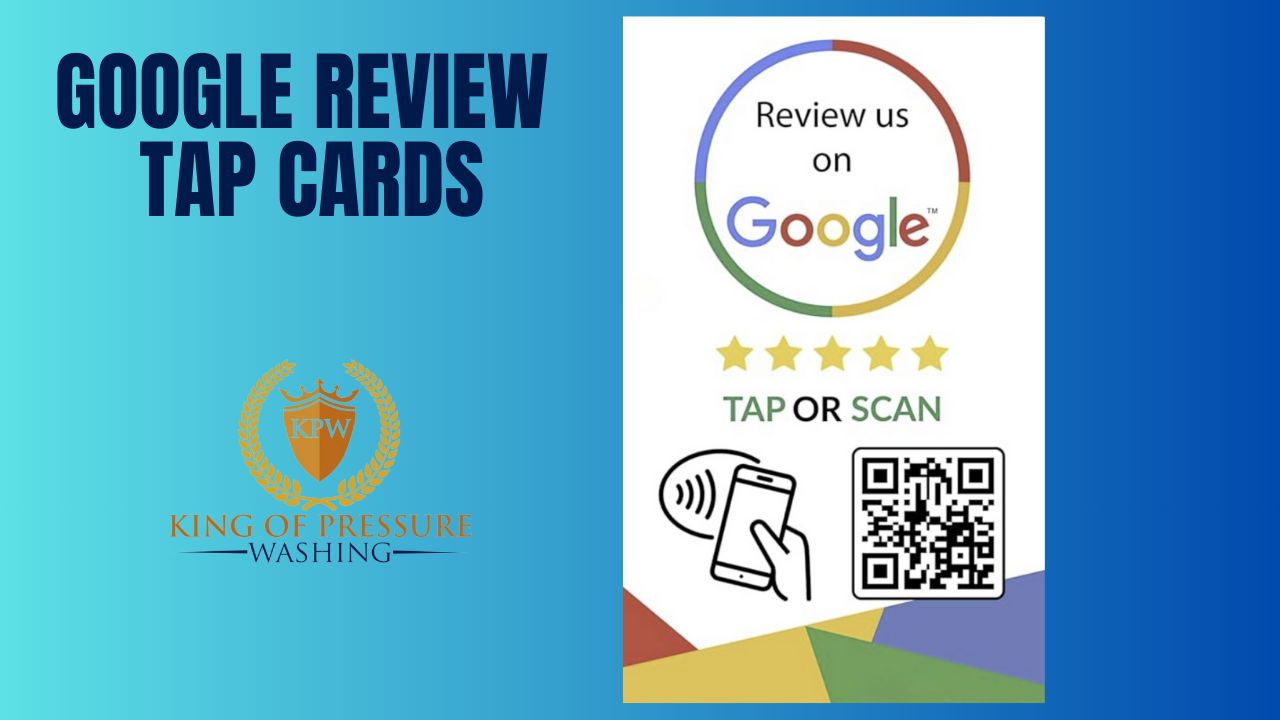
The correct approach is immediate capture: "Awesome! Let me pull up the review page on your phone right now and we can get that posted while it's fresh in your mind." Using NFC tap cards or QR code review cards eliminates friction—customers simply tap their phone against the card or scan a code, and the Google review page opens instantly.
Touch Six: Guided Review Writing
Once the review page is open, help customers write meaningful reviews by suggesting specific elements: mention the city or neighborhood, reference "pressure washing" explicitly (not just "house washing"), describe the specific services performed, and include any standout details about the experience.
This guidance serves dual purposes. First, it makes the review process easier for customers who often don't know what to write. Second, it ensures reviews contain keywords and location markers that benefit your local SEO efforts.
Touch Seven: Follow-Up Sequence
For customers who weren't home during service, implement a systematic follow-up sequence: send a text message immediately after completion, send an email within an hour, make a follow-up call the next day, send another text reminder if needed, and send a final email reminder three days later.
The follow-up call provides opportunity for quality control while positioning the review request: "I just wanted to make sure you're completely satisfied with how everything turned out. How does it look?" After confirming satisfaction: "That's great to hear! Would you be willing to leave us a five-star review? It really helps our business. I'm going to text you a link right now—it only takes 60 seconds."
Review Cards and NFC Technology
Physical review tools dramatically improve conversion rates compared to digital-only approaches. Two primary options exist: traditional QR code review cards and NFC tap cards.
QR code review cards feature scannable codes that open review pages when photographed with a smartphone camera. These cards typically measure credit-card size, making them easy to carry in technician wallets or vehicle door pockets. Many operators print dual-sided cards with Google reviews on one side and referral information on the other.
NFC tap cards represent the newer technology. These cards contain embedded chips that trigger automatic actions when tapped against NFC-enabled smartphones (which includes most devices manufactured after 2018). Simply tapping the phone against the card instantly opens the Google review page without requiring camera access or scanning.
The psychological advantage of physical cards is significant. When technicians produce a card and demonstrate the review process in real-time, it removes any ambiguity or technical confusion. Customers see exactly how simple the process is, eliminating the "I'll do it later" response that rarely converts.
Gamifying Review Generation for Employee Teams
For operators with multiple technicians, employee engagement directly impacts review generation success. The most effective approach involves gamification with tiered rewards based on review quality and content.
Create a basic reward structure: $5 per five-star review, an additional $5 if the review mentions the technician by name, another $5 if the review includes a photo, and potentially $10-$15 for video testimonials. These incremental rewards motivate technicians to not just ask for reviews but to help customers create rich, detailed reviews that provide maximum marketing value.
Track results publicly through leaderboards displayed in the shop or company communication channels. Public recognition combined with financial incentives creates healthy competition that elevates everyone's performance. Many operators report their "C-level" technicians transforming into top performers once review generation became gamified with clear rewards.
Strategic Review Content Optimization
Not all five-star reviews provide equal value. Strategic guidance during review creation maximizes SEO benefits while building more persuasive social proof.
Encourage customers to include specific location markers: neighborhood names, nearby landmarks, or city references. These local signals help Google understand your service area relevance and improve visibility for location-based searches like "pressure washing in [neighborhood name]."
Request mention of specific services using industry-standard terminology. Rather than generic praise, reviews that mention "pressure washing," "house washing," "concrete cleaning," "roof soft washing," or "driveway cleaning" contain keywords that support search visibility for those specific services.
Guide customers toward describing outcomes and experiences rather than just stating "good service." Reviews that describe the dramatic transformation of their property, the professionalism of the crew, or the surprising speed of completion provide richer social proof that resonates with prospects reading reviews.
The Role of Customer Photos and Video Testimonials
Text reviews provide valuable social proof, but reviews accompanied by customer-submitted photos or videos carry exponentially more weight. These rich media reviews stand out visually in review listings, capture attention, and provide undeniable proof of quality work.
Encourage photo submissions by making it easy: "Would you mind taking a quick photo of your clean house and adding it to your review? It really helps other homeowners see what we can do." Most customers are happy to comply with this simple request, especially when they're proud of how their property looks.
Video testimonials represent the ultimate social proof format. While they require more customer effort, they're worth pursuing for exceptional projects or particularly enthusiastic customers. Even 15-30 second smartphone videos where customers describe their satisfaction create powerful marketing assets that can be repurposed across multiple channels.
What to Do When Customers Aren't Home
Many pressure washing jobs occur while customers are at work or away from home. This presents challenges for immediate review capture but doesn't eliminate the opportunity—it simply requires more systematic follow-up.
Before leaving the property, send a text message: "Hi [Name], we just finished cleaning your property. Everything looks great! We'll follow up with you tomorrow to make sure you're completely satisfied." This establishes that you'll be contacting them and primes them for the review request.
Make the follow-up call within 24 hours: "Hi [Name], I wanted to check in and make sure you got a chance to see the work we did yesterday. How does everything look?" After confirming satisfaction, transition to the ask: "That's wonderful to hear! Would you be willing to leave us a five-star review? I'm texting you a link right now—it only takes about a minute."
The key is sending the review link during the phone conversation, not after. Tell them it's coming, send it while they're on the line, and stay on the phone to answer any questions about the process. This real-time assistance dramatically improves completion rates.
Alternative Review Platforms Beyond Google
While Google reviews should be the primary focus due to their impact on local search visibility, diversifying review profiles across multiple platforms provides additional benefits.
Yelp reviews, despite the platform's controversial review filtering practices, contribute to AI-powered search results and recommendations. Yelp integration with ChatGPT means reviews on this platform influence AI-generated business recommendations—an increasingly important channel as consumers adopt AI assistants for local service research.
Facebook reviews provide social proof on the platform where many customers first discover your business. While they don't impact Google search rankings, they influence decision-making for customers engaging with your Facebook presence.
The practical approach for multi-platform review generation is creating dual-purpose review cards: one QR code or NFC action for Google, another for Yelp or Facebook. If customers can't log into Google easily, offering an alternative platform ensures you still capture the review rather than losing it to technical friction.
Monitoring Your Review Profile Competitively
Understand your competitive positioning by regularly auditing review profiles of key competitors in your service area. How many total reviews do they have? What's their average rating? How recently are they generating new reviews? This intelligence reveals whether your review generation efforts are sufficient to maintain competitive advantage or whether increased urgency is needed.
Use this competitive context in your marketing messaging when appropriate. If you legitimately have more five-star reviews than any competitor in your market, that's a powerful differentiation point worth emphasizing in ads, website copy, and sales presentations.
The Photos You Post Matter As Much As Reviews
Review generation doesn't exist in isolation from your overall Google Business Profile strategy. The photos you regularly post to your profile significantly impact the types of customers you attract and the pricing they're willing to pay.
Avoid the common trap of exclusively posting dramatic before-after photos of heavily soiled properties. While these transformations impress fellow pressure washers, they don't represent your ideal customer profile. Most customers hiring professional services live in well-maintained properties that need regular cleaning rather than rescue missions.
Post photos showcasing beautiful homes, professional crew members in uniform, wrapped vehicles parked in upscale neighborhoods, and spotless results that emphasize maintenance rather than restoration. These images attract premium customers who value prevention and maintenance—the customer segment most likely to appreciate your professionalism and pay your rates without negotiation.
1. How many five-star reviews should I aim to collect in 2026?
A practical target for established businesses is 60+ reviews within the year, which breaks down to approximately five reviews monthly. New businesses should aim even more aggressively—targeting 8-10 reviews monthly during their first year to quickly build credibility and competitive positioning. The specific number matters less than consistency—regular review generation signals to Google that you're an active, legitimate business consistently delivering satisfaction. If your primary competitor has 200 reviews and you have 50, prioritize aggressive review generation until you've closed that gap significantly.
2. What's the best way to ask for reviews without seeming pushy?
Frame review requests around helping rather than asking. Use language like "Would you be willing to help us out by leaving a quick review?" or "If you're happy with the work, a five-star review really helps our small business." When you've just delivered exceptional results and the customer is genuinely satisfied, asking for a review is the natural conclusion to a successful service experience. The key is timing—ask immediately after confirming satisfaction rather than days later when enthusiasm has faded. Using physical review cards (NFC tap cards or QR codes) also reduces the "pushy" feeling by making the process feel simple and helpful rather than burdensome.
3. Should I offer incentives or discounts in exchange for reviews?
No—offering compensation for reviews violates Google's review policies and risks having your entire review profile penalized or removed. However, you can create internal team incentives where your employees earn bonuses for reviews they generate, as this doesn't involve directly compensating the customer. The proper approach is making the review process so easy and the service so exceptional that customers want to leave reviews without any external motivation beyond helping a business they genuinely appreciate.
4. What do I do if a customer can't log into their Google account to leave a review?
Have a backup option ready—this is where having both Google and Yelp (or Facebook) options on your review card proves valuable. If the customer struggles with Google login credentials, offer Yelp as the alternative. While Yelp has its challenges, it's better to capture a review on a secondary platform than lose it entirely to technical friction. You can also offer to send the review link via text or email so they can complete it later when they have access to login credentials, though immediate completion always yields higher conversion rates.
5. How should I respond to negative reviews?
Respond quickly (within 24-48 hours), professionally, and constructively. Acknowledge the customer's concern, apologize for their negative experience, explain what happened from your perspective if appropriate, and offer to make things right. Never argue, never get defensive, and never let emotions drive your response. Potential customers reading your reviews will judge your business as much by how you handle criticism as by the positive reviews themselves. Often, a professional response to a negative review can actually improve your reputation by demonstrating accountability and customer service commitment.
6. Can I ask customers to edit or remove negative reviews?
You can politely ask if they'd be willing to update their review after you've resolved their concern. The appropriate approach: fix the problem thoroughly, follow up to confirm satisfaction, then say "We really appreciate you giving us the chance to make this right. If you feel we've addressed your concerns, would you be willing to update your review to reflect the resolution?" Many customers will remove or modify negative reviews if you've genuinely resolved the issue, but never pressure or incentivize this—it must be their voluntary choice based on improved satisfaction.
7. How do review cards work with NFC technology?
NFC (Near Field Communication) tap cards contain embedded chips that communicate with smartphones when held within a few inches of the device. When a customer taps their NFC-enabled phone against your review card, it automatically triggers a pre-programmed action—typically opening your Google review page in their browser. This requires no app download, no QR code scanning, and no typing of URLs. The customer simply taps their phone against the card and the review page appears instantly. Most smartphones manufactured after 2018 have NFC capability, making this the smoothest review capture method available.
8. Should I focus on Google reviews exclusively or diversify across platforms?
Prioritize Google reviews heavily (80%+ of effort) since they directly impact local search visibility and map pack rankings—your most valuable lead generation channels. However, maintaining presence on Yelp provides backup value since Yelp integrates with AI platforms like ChatGPT for business recommendations. Facebook reviews matter for customers who discover you through social media. A practical approach is defaulting to Google for every review request but having Yelp or Facebook as backup options when customers encounter Google login issues. Don't spread efforts too thin across six different platforms—focus intensely on Google with Yelp as secondary priority.
9. How do I systematize review requests when customers aren't home during service?
Create a documented follow-up sequence that triggers automatically: text message immediately after job completion confirming work is done, email within 1-2 hours with before-after photos and review request link, phone call next business day to confirm satisfaction and request review, second text reminder 48 hours post-service if no review received, final email reminder at 7 days post-service. Use your CRM to automate these touchpoints and assign follow-up tasks to administrative staff. The personal phone call yields the highest conversion rate, so prioritize this over automated messages whenever possible.
10. What should I include in my review request messaging to maximize response rates?
Keep the message personal, specific, and action-oriented. Poor example: "If you have time, please leave us a review." Better example: "Hi [Name], I'm so glad we could get your house looking great again! If you're happy with the results, would you leave us a quick five-star review? I'm texting you the link right now—it only takes 60 seconds and really helps our small business. Thanks so much!" The better version uses their name, references the specific work performed, makes the ask clear and direct, specifies five-star explicitly, communicates the time requirement (removes objections), explains why it matters, and includes immediate call-to-action.
