
The #1 Mistake Pressure Washers Make That Kills Their Average Ticket
Jan 13, 2026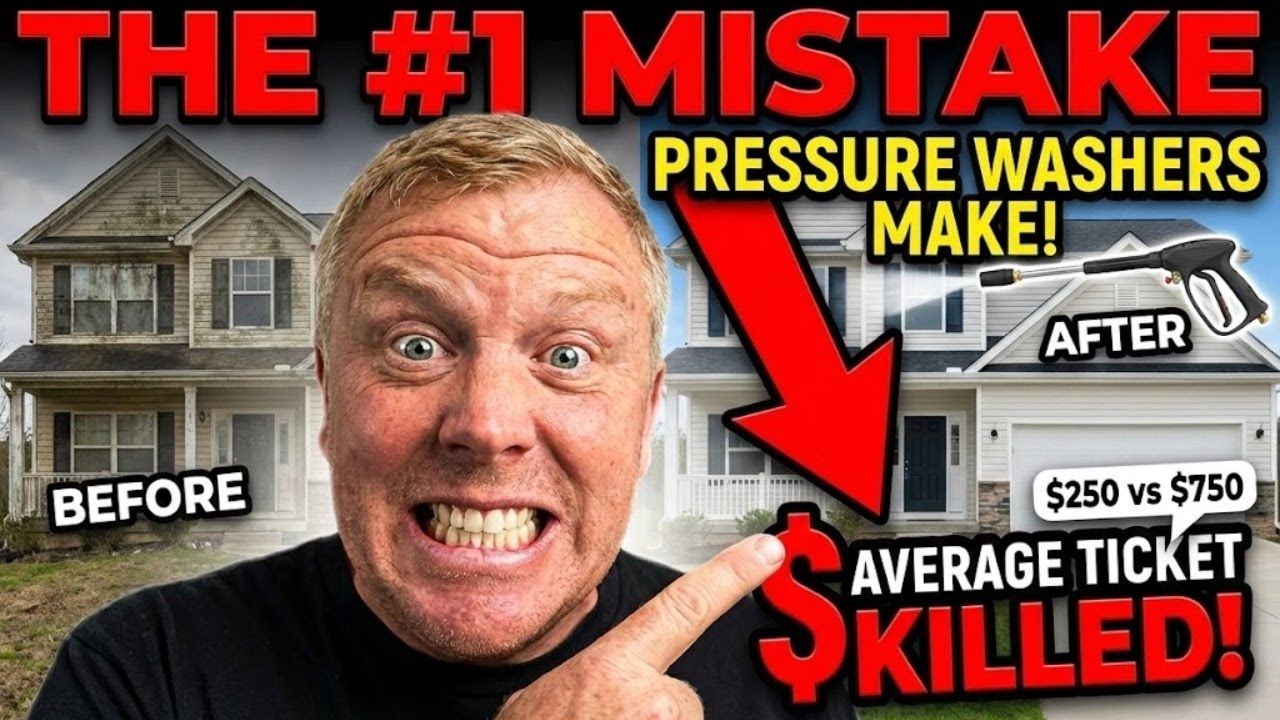
Growing a successful pressure washing business isn't just about working harder or completing more jobs. The real secret to building a profitable, sustainable business lies in understanding how to increase your average ticket value while actually doing less work. This counterintuitive approach has helped countless operators double their revenue without burning themselves out in the process.
The Power of Package Pricing
The fundamental mistake most pressure washing operators make is itemizing individual services instead of presenting complete solutions through strategic package pricing. When a potential customer calls requesting a house wash, quoting only that single service leaves thousands of dollars on the table every single time.
Consider this real-world example: An operator in Syracuse, New York was generating approximately $150,000 annually before implementing package pricing strategies. Within just one year of switching to bundles and raising prices accordingly, revenue jumped to $300,000—while actually completing fewer total jobs. The difference wasn't working harder or longer hours. The difference was strategic packaging that increased average ticket value from the mid-hundreds to over $1,500 per job.
Understanding What Customers Really Need
When Mrs. Jones calls requesting a house wash, she likely needs far more than just that single service. Her windows probably need cleaning. Her driveway almost certainly needs attention. Her roof might benefit from soft washing. Her gutters could use brightening. By only quoting the house wash she specifically requested, you're not serving her complete needs—and you're dramatically limiting your revenue potential.
The strategic approach involves presenting comprehensive solutions that address all visible property maintenance needs, packaged in a way that makes decision-making simple while maximizing the value you provide and the revenue you generate.
The Three-Package Framework
Research in consumer psychology consistently demonstrates that offering three distinct package options creates the optimal decision-making environment for customers. More than three options creates overwhelming complexity that paralyzes decision-making. Fewer than three eliminates the comparison framework that helps customers feel confident in their choices.
Why Three Packages Work
The three-package structure serves multiple strategic purposes simultaneously. First, it eliminates the simple yes/no decision about whether to hire you at all, replacing it with a choice between three different value levels. This psychological shift dramatically increases conversion rates because the question changes from "Should I hire them?" to "Which package makes the most sense for me?"
Second, the highest-priced package serves as an anchor that makes your mid-tier and basic packages appear more reasonable by comparison. This anchoring effect is well-documented in negotiation and sales psychology. When customers see a $2,000 premium package first, a $1,200 standard package suddenly seems quite reasonable rather than expensive.
Third, different customer personalities naturally gravitate toward different package levels based on their values and decision-making styles. Some customers always buy premium everything—they drive luxury vehicles, live in upscale neighborhoods, and want the absolute best service available. These customers will choose your top package. Budget-conscious customers appreciate having an entry-level option that fits their financial constraints. The majority of customers will select your middle package, which typically generates the best balance of value and profitability.
Building Your Package Structure
For most residential pressure washing operations, an effective three-package structure looks like this:
Basic Package: House wash only. This serves as your entry-level offering for budget-conscious customers and provides a floor price that defines your minimum service value. Even your basic package should be priced to support proper insurance, quality service delivery, and reasonable profit margins.
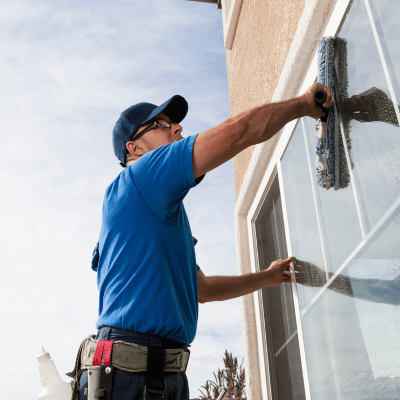
Standard Package: House wash plus exterior window cleaning. This combination takes minimal additional time—typically 20-30 minutes for window cleaning—while adding $200-$300 to the ticket. The labor-to-revenue ratio on exterior window cleaning is exceptional, and it dramatically improves the property's overall appearance, increasing customer satisfaction.
Premium Package: House wash, exterior window cleaning, and driveway/concrete cleaning. This complete property transformation typically commands $1,500-$2,000+ for average-sized residential properties. The comprehensive nature of this package maximizes both customer value and your revenue per job.
Adapting to Regional Differences
Not all markets have the same physical characteristics. In regions where asphalt driveways predominate rather than concrete, the standard three-package structure requires modification. Consider substituting roof soft washing, gutter cleaning and brightening, deck cleaning, or other relevant services for the concrete cleaning component.
The key principle remains constant: offer three distinct value levels that provide clear differentiation while addressing the complete scope of property maintenance needs your typical customer faces.
The Mathematics of Average Ticket Growth
Understanding the mathematical impact of increasing average ticket value reveals why this strategy is so transformative for business growth and profitability.
The $5,000 Monthly Revenue Example
Consider an operator targeting $5,000 in monthly revenue to cover living expenses and basic business operations. At a $500 average ticket, reaching this goal requires completing 10 jobs monthly—approximately 2-3 jobs weekly depending on the month. This is certainly achievable but requires consistent marketing and lead generation to maintain that job volume.
Now consider the same $5,000 monthly revenue target with strategic package pricing that increases average ticket to $1,000. Suddenly you only need 5 jobs monthly—roughly one job per week plus one additional job sometime during the month. The marketing pressure decreases significantly, travel time and expenses drop substantially, physical wear and tear on equipment and personnel reduces dramatically, and you have far more time available for business development, relationship building, and quality service delivery.
Push average ticket to $1,500 through comprehensive premium packages, and you need fewer than four jobs monthly to hit the same revenue target. The operational simplicity and profit margin improvement at this level transforms the entire business model.
Scaling to Six Figures
The impact becomes even more dramatic when targeting six-figure annual revenue. At $500 average ticket, generating $100,000 annually requires completing 200 jobs—a significant operational challenge requiring consistent marketing, efficient scheduling, and substantial equipment use.
At $1,000 average ticket through package pricing, the same $100,000 revenue requires only 100 jobs annually. At $2,000 average ticket (achieved by operators who systematically quote comprehensive property transformation packages), you need just 50 jobs annually to reach six figures.
Operators successfully implementing comprehensive package strategies report average tickets of $2,000-$2,100, with some quoting $4,000+ for complete property services including house washing, window cleaning, concrete cleaning and sealing, roof soft washing, gutter brightening, and oxidation removal. These operators complete fewer than 50 residential jobs annually while generating six-figure revenue.
Implementation Strategies: Online vs. In-Person Quoting
The tactical approach to presenting packages differs depending on whether you use online quoting systems or in-person estimates.
Online Quoting with Packages
For online quoting systems, the three-package structure works exceptionally well because software platforms can present all three options simultaneously in a clean, professional format. Customers can review options at their convenience, compare features and pricing, and make decisions without sales pressure.
Platforms like Responsive Bid excel at presenting tiered package options clearly. The system automatically calculates pricing based on property characteristics and displays all three packages with clear descriptions of what each includes. Customers simply select their preferred package, and the booking process proceeds seamlessly.
The key advantage of online quoting is speed and convenience. You can provide accurate quotes within 10 minutes of receiving the inquiry, dramatically reducing the time between initial contact and purchase decision. This speed is increasingly important in markets where customers expect immediate responses and compare multiple providers quickly.
In-Person Quoting with Packages
In-person quoting requires a more consultative approach but often achieves higher average tickets and close rates. The process involves walking the property with the customer, discussing their concerns and needs, identifying all areas requiring attention, then sitting down together (ideally at the kitchen table, which research shows significantly improves close rates) to present a comprehensive solution.
During the property walkthrough, experienced operators identify every service need without making the customer feel pressured. They build rapport, demonstrate expertise, and establish trust. Once back at the kitchen table, they don't immediately jump into pricing. Instead, they invest 10-15 minutes in relationship building and needs confirmation before presenting the quote.
When presenting packages in person, lead with the premium package that addresses every identified need. Present the complete investment required, then pause and wait for the customer's response. If they indicate the price is higher than expected, simply remove one service component to bring them to the standard package level. If that's still too high, present the basic house wash package.
This approach positions you as a comprehensive solution provider rather than a commodity service vendor, and it ensures you capture maximum revenue from every opportunity.
The KPI That Changes Everything
Average ticket value is a Key Performance Indicator (KPI) that directly impacts virtually every aspect of your business performance. Tracking this metric religiously and focusing on strategies to improve it creates cascading benefits throughout your operation.
Marketing ROI Improvement
Higher average tickets mean you can afford more aggressive marketing investment while maintaining healthy profit margins. If you generate $500 per job, spending $100 on marketing to acquire each customer consumes 20% of revenue. At $1,500 per job, that same $100 marketing cost represents only 6.7% of revenue, leaving substantially more profit while potentially allowing increased marketing spend to accelerate growth.
Operational Efficiency
Fewer jobs at higher ticket values mean less travel time between jobs, reduced fuel expenses, lower equipment wear and tear, fewer customer communication touchpoints, and more time available for business development and strategic activities rather than constant execution mode.
Employee Compensation
Higher revenue per job enables better employee compensation without destroying profit margins. When your average ticket is $500, paying a technician 30% commission means they earn $150 per job. At $1,500 average ticket with the same 30% structure, they earn $450 per job—a dramatic income improvement that helps attract and retain quality team members.

Overcoming Price Resistance and Mindset Barriers
The single biggest obstacle to implementing premium package pricing isn't market conditions, competition, or customer pushback—it's the business owner's own limiting beliefs and fear.
The "My Market Is Different" Myth
Every market has operators insisting "you can't charge those prices here" or "my area is too competitive" or "customers won't pay that much in this region." These statements are almost always false beliefs rather than market realities.
The truth is that every market has customer segments willing to pay premium prices for quality service, convenience, and comprehensive solutions. You're not trying to serve the entire market—you're targeting the customers who value what you provide and can afford to pay appropriately.
When you hear yourself thinking "my market won't support premium pricing," recognize this as a limiting belief rather than market analysis. Numerous operators in every geographic region successfully charge premium prices while maintaining strong demand.
Building Pricing Confidence
Pricing confidence comes from understanding your true business costs and the genuine value you provide. When you account for insurance, equipment depreciation, vehicle costs, marketing expenses, administrative time, and the expertise you've developed, suddenly premium pricing isn't greed—it's basic business mathematics.
Customers aren't buying pressure washing—they're buying clean, attractive properties that make them proud, eliminate stress about property maintenance, create curb appeal that impresses neighbors and protects property values, and provide time freedom from handling these tasks themselves. When you frame your service in terms of these genuine benefits rather than commoditized task completion, premium pricing makes perfect sense.
The First Customer at Higher Prices
The hardest part of implementing premium pricing is closing your first customer at the new price level. Once you've successfully sold one package at $1,500 or $2,000, your confidence soars because you've proven to yourself that the market will support your pricing.
If you're currently at $500-$600 average ticket, don't try to jump immediately to $2,000. Implement packages that move you to $800-$1,000 first. As you gain confidence and refine your presentation, gradually increase pricing until you reach optimal levels for your market and business model.
Taking Action in 2026
The pressure washing business isn't rocket science—the technical work is straightforward and learnable. The challenge is business development: generating consistent leads, converting estimates to jobs, delivering quality service, and pricing appropriately to build a sustainable, profitable business.
Package pricing represents one of the highest-impact strategies you can implement to dramatically improve business performance without working harder or longer hours. The transition requires courage to present higher prices and confidence to wait quietly after presenting the investment rather than immediately offering discounts or backing down.
Start by defining your three packages clearly. Know exactly what each includes and the specific investment required. Practice presenting packages until you can do it naturally and confidently. Track your average ticket religiously to measure improvement. Celebrate small wins as average ticket increases, and use the additional revenue to invest in marketing that generates more opportunities.
The operators who will dominate in 2026 are those who position themselves as premium solution providers rather than commodity service vendors. Package pricing is the practical manifestation of this positioning—and it's the fastest path to doubling your revenue while improving your quality of life.

1. What should my three package tiers include for residential pressure washing?
For most residential operations, structure packages as: Basic (house wash only), Standard (house wash + exterior window cleaning), and Premium (house wash + exterior window cleaning + concrete/driveway cleaning). The exact composition depends on your regional characteristics—if asphalt driveways are common rather than concrete, substitute roof soft washing, gutter cleaning/brightening, or deck cleaning in your premium package. The key is providing clear value differentiation between tiers while addressing comprehensive property maintenance needs in your top package.
2. How much should I charge for each package level?
Pricing depends on property size and regional market factors, but effective ranges are: Basic package $500-$700 for average single-story homes, Standard package $800-$1,200 adding exterior windows, Premium package $1,500-$2,500 for complete property transformation. Your premium package should be priced high enough to serve as an effective anchor (making middle tier appear reasonable) while still representing genuine value for customers who want comprehensive service. Track your average ticket across all three packages—it should land around 50% of your premium package price.
3. Won't offering three packages confuse customers or overwhelm them?
Research in consumer psychology demonstrates that three options represents the optimal number for decision-making. Fewer than three eliminates comparison framework; more than three creates overwhelming complexity. Three packages shifts the customer decision from "Should I hire them?" to "Which package makes sense for me?"—a fundamentally different question that increases conversion rates. Present packages clearly with distinct service components, and customers will appreciate having options that match their budget and needs.
4. Should I present packages differently for online vs. in-person estimates?
Yes, tactical presentation differs. For online quoting (using systems like Responsive Bid), present all three packages simultaneously with clear descriptions and pricing so customers can compare and select at their convenience. For in-person estimates, walk the property identifying all needs, then sit at kitchen table and lead with premium package that addresses everything. If customer indicates price is high, remove one component to reach standard package, then basic if necessary. In-person approach typically achieves higher average tickets through relationship building and consultative sales.
5. What if customers always choose the cheapest package?
If customers consistently select your basic package, your pricing structure may need adjustment. The basic package might be too attractively priced relative to higher tiers, your premium package may not be compelling enough (add more services to increase perceived value), or you may need to improve your presentation of the value provided in standard and premium packages. Aim for distribution where 10-20% buy premium, 60-70% buy standard, and 10-20% buy basic. If you're getting 70%+ basic package selections, revisit your package construction and presentation.
6. How do I build confidence to present higher prices without immediately offering discounts?
Confidence comes from understanding your true costs and genuine value provided. Calculate your actual business expenses (insurance, equipment depreciation, vehicle costs, marketing, administrative time, expertise development) to recognize that premium pricing is business necessity, not greed. Start by practicing package presentations until they feel natural. After presenting investment, stay quiet—first person who speaks loses negotiating position. Remember customers aren't buying pressure washing tasks; they're buying property pride, stress elimination, curb appeal, and time freedom. Frame value in these terms rather than commoditized task completion.
7. Can package pricing work in highly competitive markets?
Package pricing works in every market because you're differentiating on value rather than competing on price alone. Even highly competitive markets have customer segments willing to pay premium prices for comprehensive solutions, quality service, and reliable providers. You're not trying to serve everyone—target customers who value what you provide. Operators in extremely competitive markets successfully maintain premium pricing by positioning as solution providers rather than commodity vendors. Focus on ideal customers rather than trying to be cheapest option for price-sensitive segments.
8. What's the fastest way to increase my current average ticket?
Add exterior window cleaning to your standard offering—this single addition typically increases average ticket by $200-$300 while requiring only 20-30 minutes of additional labor. Equipment investment is minimal (water-fed pole and DI tank under $1,000). Then structure proper packages presenting comprehensive solutions rather than itemizing individual services. When customer calls for house wash, present complete package including windows and concrete rather than just the single service requested. Track average ticket weekly to measure improvement and celebrate progress.
9. Should I discount packages or offer promotional pricing?
Avoid discounting whenever possible because it trains customers to expect reduced pricing and devalues your service. Packages themselves provide built-in "discount" perception—customers get more services for less than purchasing individually would cost. If customer requests discount, offer to remove a service component rather than reducing price: "I can definitely work with your budget—would you prefer I remove the window cleaning or the concrete cleaning to bring investment down?" This maintains pricing integrity while providing flexibility.
10. How do packages affect my marketing and lead generation?
Higher average tickets dramatically improve marketing ROI because you can spend more to acquire each customer while maintaining healthy margins. At $500 per job, spending $100 to acquire a customer consumes 20% of revenue; at $1,500 per job, same $100 represents only 6.7% of revenue. This enables more aggressive marketing investment (yard signs, door knocking, Facebook ads, Google Ads) while still remaining profitable. Package pricing also differentiates you from competitors in marketing messages—position as comprehensive solution provider rather than commodity service vendor competing primarily on price.
