
How to Price Pressure Washing Jobs: A Real-World Guide to Charging What You're Worth
May 24, 2026
There's one mistake that keeps more pressure washing businesses broke than anything else, and it isn't bad equipment, a slow market, or too much competition. It's bad pricing. Most guys charge too little because they're scared to lose the job, and they end up working twice as hard for half the money.
Here's the truth: there is no single "right" price for a house wash, a driveway, or a roof. Anyone who hands you one flat number for the whole country either doesn't run a real business or is trying to sell you something. What you actually need is a framework — the general ranges the market supports, and the factors that decide where you land inside those ranges.
That's exactly what this guide gives you. At King of Pressure Washing, we coach contractors through this every week, and the operators who price with a system instead of a gut feeling are the ones who scale. Use these ranges as a starting point, plug in your own market and your own costs, and quote with confidence.
Quick answer: In most U.S. markets, a professional house wash usually runs from the mid hundreds into the low thousands, depending on size, stories, and condition. Driveways and patios tend to land in the low-to-mid hundreds. Decks and fences sit in the same neighborhood. Roof soft washing is almost always the highest-ticket routine job because of the chemistry, the height, and the substrate risk. Commercial work shifts to per-square-foot or contract pricing, and every small job should be protected by a minimum service fee.
Why There's No "One Price" in Pressure Washing
If you've ever Googled "how much to charge for pressure washing," you've seen wild disagreement. That's not because the sources are wrong — it's because they're measuring different things.
Some price a house wash off the home's listed square footage. Others price off the actual cleanable exterior surface. Some quote a clean concrete driveway; others quote one with oil stains baked in for ten years. And small jobs blow up simple square-foot math because your minimum charge takes over. A tiny walkway can look like pocket change on a per-square-foot calculator, but it still costs you the same drive time, setup, and chemical prep as a bigger job — so it has to invoice in the low hundreds to make sense.
That's the real lesson. Your price isn't just about square footage. It's about square footage plus everything else. Once you understand that, the ranges below stop being confusing and start being a tool.
General Pricing Ranges by Service
These are directional ranges for a standard residential job in a typical market — easy access, on-site water, normal soil, no major restoration. Adjust up or down for your area and the job in front of you.
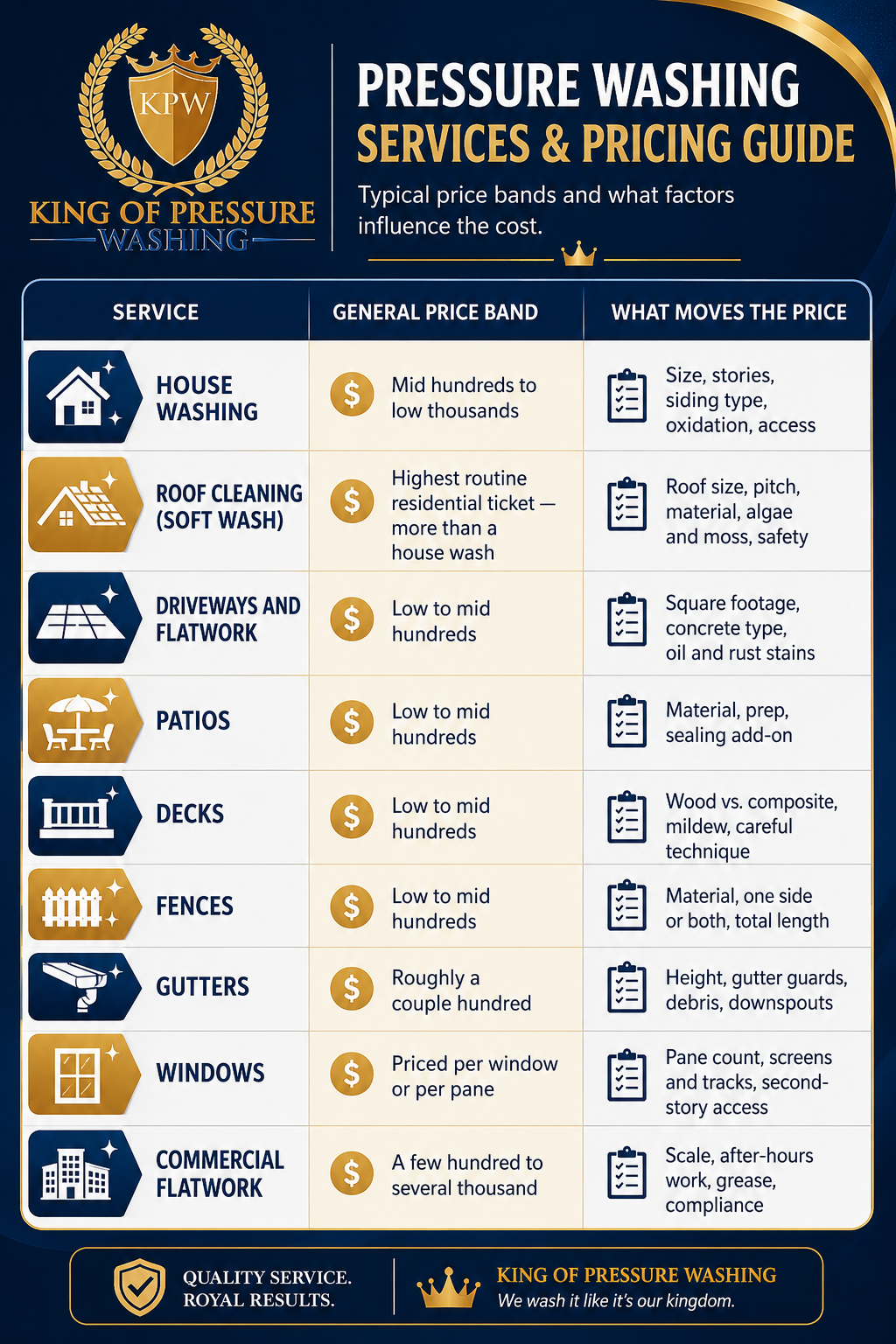
House Washing
House washing is your bread and butter, and it usually runs anywhere from the mid hundreds into the low thousands. Most of these are actually soft washes, not high-pressure blasting — you're letting chemistry do the work on siding, not trying to strip the paint off. The big swing factors are how many stories you're working, the siding material, and how oxidized or neglected the exterior is. A small single-story home sits at the bottom of that range; a big two-story with heavy oxidation can climb toward the top.
Roof Cleaning
Roof cleaning sits at the top of the routine residential stack, and it should. You're dealing with height, slope, delicate material, and the algae and moss that take real dwell time to kill. One rule that's non-negotiable: never put a power washer on an asphalt roof. The roofing industry is explicit about that — high pressure tears up the shingles and voids warranties. Legitimate roof cleaning is a low-pressure soft wash, and your price should reflect the chemistry, the safe access, and the risk you're taking on.
Driveways, Patios, and Other Flatwork
Flatwork is the most standardized work you'll do, which is why it's the easiest to underprice. A clean driveway or patio is a low-to-mid hundreds job, and it's often quoted by the square foot — but the moment oil, rust, or rust-stained concrete enters the picture, that's a separate line item, not a freebie. Treat tough stains as their own charge every single time.
Decks and Fences
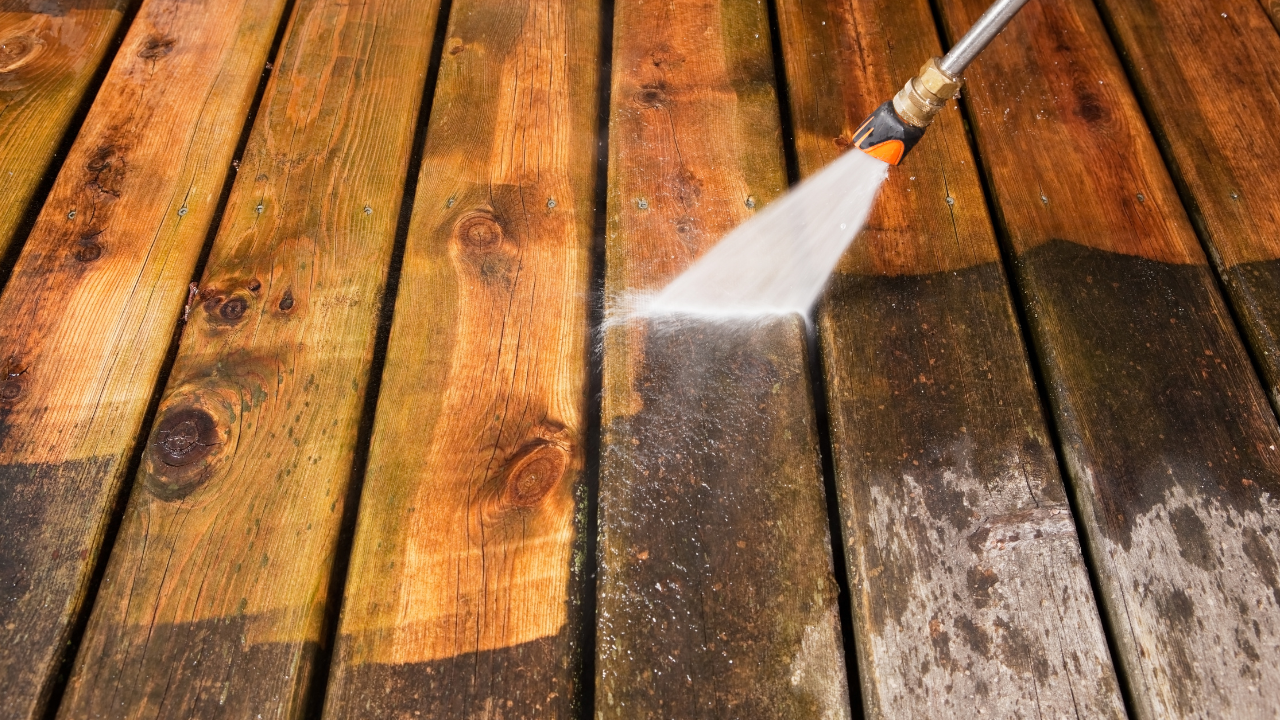
Decks and fences live in the same budget zone, but for different reasons. A standard deck clean is low-to-mid hundreds, but the price climbs fast when the wood is in rough shape or the customer wants it done carefully without fuzzing the grain. Fences are similar — and don't forget to charge for both sides if that's what they're expecting.
Gutters and Windows
These two often use different units than your core washing. Gutters are commonly priced per linear foot or as a flat rate by story, usually landing around a couple hundred dollars. Windows are almost always priced per window or per pane. The number sounds small, but it adds up — and screens, tracks, and hard-water spots are all add-ons, not part of the base.
Pricing Commercial and Light Commercial Work
Commercial work is a different game, and it's where a lot of pressure washing businesses make the jump from side hustle to real company. You're no longer quoting a homeowner an emotional, one-time number — you're quoting a property manager or business owner on production: how much area, how fast, how often, and what it takes to do it right.
That means commercial almost never uses consumer-style flat totals. You'll price it one of three ways: per square foot for predictable flatwork, hourly when the scope is messy or unknown, or a flat contract for recurring accounts. The work itself runs the gamut — storefronts and entryways, sidewalks and walkways, building exteriors, dumpster pads, drive-thru lanes, gas station aprons, and parking lots or garages.
On price, a small commercial job like a single storefront or a short stretch of sidewalk often lands in the few-hundred-dollar range, while large facilities, big lots, and multi-building properties climb well into the thousands. The spread is huge because the variables are huge. Three things drive it more than anything else:
- Grease and heavy soil. Restaurant pads, dumpster areas, and drive-thrus are caked in grease that cold water won't touch. That usually means hot water and stronger degreasers, and heated work commands a premium over standard cold-water washing. Charge for it.
- Scheduling. A lot of commercial work has to happen after hours or before open so you're not blasting customers with overspray. Night and early-morning work disrupts your labor and deserves a higher rate.
- Compliance. This is the one that trips up new operators. Wash water from commercial sites often can't simply run into a storm drain — in many areas it's treated as industrial wastewater, and you may be required to capture, contain, or reclaim it. Some jobs need permits, water recovery equipment, and documentation. Build that time and gear into your bid, or it eats your profit.
Here's the upside that makes all of it worth it: commercial is where recurring revenue lives. A homeowner calls you once a year. A property manager with ten locations can put you on a monthly or quarterly schedule and fill your calendar with predictable, routed work. Those contracts are worth a small discount because the volume, the route density, and the steady cash flow more than make up for it.
The one rule with commercial: bid it carefully. Walk the site, count the square footage, and note the water source, the access, the grease, and the schedule before you ever send a number. The jobs that lose money are the ones quoted from the truck window.
The Real Factors That Move Your Price
This is the part most operators skip, and it's where the money is. Two identical houses can have completely different price tags. Here's what decides it.
Things that push your price up:
- Height and ladder work. A second story is slower, riskier, and harder to set up. Charge for it.
- Heavy staining. Oil, rust, graffiti, severe algae — these mean more chemistry, more dwell time, and sometimes a second pass. A bad stain can push a job well above its base.
- Tough access. Steep grades, tight landscaping, no parking, no water on site. Every obstacle slows your production and costs you money.
- Specialty chemistry. Soft-wash treatments, plant protection, and delicate surfaces all add cost and care.
- After-hours and compliance. Commercial jobs that require night work, water recovery, or environmental compliance are worth more — a lot more for emergency work.
Things that pull your price down (on purpose):
- Bundling. Multiple services on the same visit share one setup and one drive. You can discount slightly and still come out ahead.
- Recurring contracts. A maintenance plan means predictable routing, less buildup, and lower acquisition cost. Reward it.
- Large uniform surfaces. Big, clean, open square footage lets you produce faster — your per-square-foot rate can come down while your hourly stays strong.
Pick a Pricing Model — and Protect Your Minimum
You don't need a different brain for every job. You need a base model and a minimum.
Most pros run one of a few base models: a flat rate for whole jobs like a house or roof, per square foot for flatwork and commercial, per linear foot for gutters and some fences, and per window or pane for glass. Pick the unit that fits the surface and stay consistent.
Then protect your minimum service fee. This is the floor you won't go below no matter how small the job is, because your truck, your fuel, your setup, and your chemicals cost the same whether you're cleaning a tiny walkway or a full driveway. Without a minimum, small jobs quietly lose you money.
The smartest operators also price to a production target — a gross-per-hour number they want to hit — instead of only thinking in square footage. When you know your hourly target, you stop quoting jobs that look fine on paper but actually pay you less than mowing lawns would.
Stack Add-Ons to Grow Your Average Ticket
Your base wash gets you in the door. Add-ons are where your average ticket actually climbs. The pros clearing real money aren't charging more per house — they're selling more per visit. You're already on site, already set up, already have the customer's attention. Every extra service you tack on is almost pure margin, because the expensive part — getting there and setting up — is already paid for.
Here are the add-ons that move the needle:
- Sealing. Concrete and paver sealing is one of the highest-value upsells in the business. After you've cleaned a driveway or patio, sealing protects it, gives it that rich wet look customers love, and is typically priced by the square foot on top of the wash. Deck sealing and staining are the same play on wood. Done right, this single add-on can rival the price of the cleaning itself.
- Stain treatment. Oil, rust, battery acid, irrigation stains, and severe organic growth all take extra chemistry and time. Never bundle these into the base wash — quote them as their own line item every single time.
- Gutter services. If you're already cleaning the house, the gutters are right there. Gutter brightening (scrubbing off those black tiger stripes), interior cleanouts, and downspout flushing are all easy adds, usually priced per linear foot or per downspout.
- Roof and debris work. Roof debris blow-off, valley clearing, and gutter-guard checks pair naturally with a soft wash and add minutes, not hours.
- Window extras. Exterior window cleaning, screen cleaning, and track detailing turn a house wash into a full exterior package. Hard-water stain removal on glass is a premium service most operators don't even offer — which means you can own it.
- Maintenance plans. The biggest "add-on" of all isn't a service, it's a schedule. Offer to come back on a recurring basis — annually for house washes, more often for commercial — and you turn a one-time job into predictable, repeat revenue.
The whole game is to actually offer them. Most operators clean the one thing the customer called about and drive off, leaving easy money on the table. Walk the property, point out what else needs attention, and present it as a package instead of a list of prices. Even a one-in-three yes rate will transform your average ticket — and your week.

Position Your Pricing Where You Want to Compete
Not every business should price the same, and not every business should chase the lowest bid. Roughly speaking, operators fall into three lanes:
- Starter. A solo operator building reviews, taking easy-access jobs, keeping the schedule full. Lower minimums, lower hourly target. This is a launch posture, not a forever posture.
- Established. Insured, dependable, clear add-ons, professional communication. This is where most healthy businesses live and where your minimum and hourly target step up.
- Premium. Strong branding, premium chemicals, white-glove service, and the confidence to take the harder, higher-paying work. This lane prices well above the bargain crowd — and the customers in it don't flinch.
The goal isn't to be the cheapest. It's to be the obvious choice for the customer who isn't shopping on price alone.
The Mistakes That Keep Pressure Washers Broke
A few pricing habits will sink you faster than anything. Being the lowest bidder trains your market to expect bargain prices and attracts the worst customers. Skipping the minimum turns small jobs into charity. Mixing your pricing units — quoting per square foot here and flat rate there with no logic — makes you look amateur and leaves money on the table. Copying your competition usually means copying someone who's barely surviving. And ignoring commercial compliance can turn a profitable contract into a legal headache.
Price like a business owner, not like a guy who's afraid of the phone. That single shift is worth more than any equipment upgrade you'll ever make.
Final Word
Pricing isn't about finding one magic number. It's about knowing your ranges, reading the factors in front of you, protecting your minimum, and stacking value until your average ticket reflects the quality you deliver. Get that right and the daily revenue takes care of itself.
If you want help dialing in your specific numbers, that's exactly what we do inside the King of Pressure Washing Premium Membership — including live Monday Night Coaching Calls at 9 PM Eastern, where you can bring a real quote and we'll work through it together. Stop guessing and start pricing like a pro.

How much should I charge for a house wash?
In most markets a professional house wash runs from the mid hundreds into the low thousands, with bigger, two-story, or heavily oxidized homes pushing toward the top of that range. Price it off the surface you're cleaning and your local market — not the cheapest guy on Facebook.
Should I price by the square foot or charge a flat rate?
Both work — pick the one that fits the surface. Flatwork and commercial jobs lend themselves to per-square-foot pricing, while whole-house and roof jobs are often easier to quote as a flat rate. The key is staying consistent so your numbers hold up.
What is a minimum service fee and why do I need one?
It's the lowest amount you'll charge for any job, no matter how small. Your setup, fuel, and chemical costs are roughly the same on a tiny walkway as on a full driveway, so a minimum keeps small jobs from quietly losing you money. Every serious operator has one.
Why does roof cleaning cost more than house washing?
Height, slope, safety, and chemistry. Roofs require a low-pressure soft wash with the right treatment and dwell time, plus the risk that comes with working up high. Never power wash an asphalt roof — it damages the shingles and can void the warranty.
How do I price commercial pressure washing jobs?
Commercial work usually moves to per-square-foot or contract pricing. Small storefronts can run a few hundred dollars while large facilities climb into the thousands. Factor in after-hours scheduling, grease, water recovery, and any environmental compliance the site requires.
Should I match my competitor's prices?
No. Your competitor might be underpricing themselves into bankruptcy. Price off your own costs, your production target, and the value you deliver. Competing on price is a race to the bottom you don't want to win.
How do I charge for tough stains like oil or rust?
Treat them as separate line items, never as part of the base wash. Heavy oil, rust, graffiti, and severe algae take extra chemistry, dwell time, and sometimes a second pass — so they can push a job well above its standard price.
What add-ons can I offer to increase my average ticket?
Concrete and deck sealing, rust and oil treatment, gutter brightening, downspout flushing, roof debris blow-off, and window extras like screens and track detailing. They're quick, high-margin, and the customer is already on site. Offer them every time.
What should I know before taking on commercial pressure washing work?
Commercial is more profitable but more complex than residential. Beyond pricing per square foot or by contract, you have to account for after-hours scheduling, heavy grease that needs hot water, and — most importantly — wash-water compliance. In many areas you can't let dirty water run into a storm drain, so you may be required to capture or reclaim it. Walk every site and bid carefully before you send a number.
How do I raise my prices without losing customers?
Raise them on new quotes first and let your work, reviews, and professionalism justify the number. Lead with value and add-ons instead of apologizing for the price. The customers who leave over a fair increase weren't your good customers anyway.
